

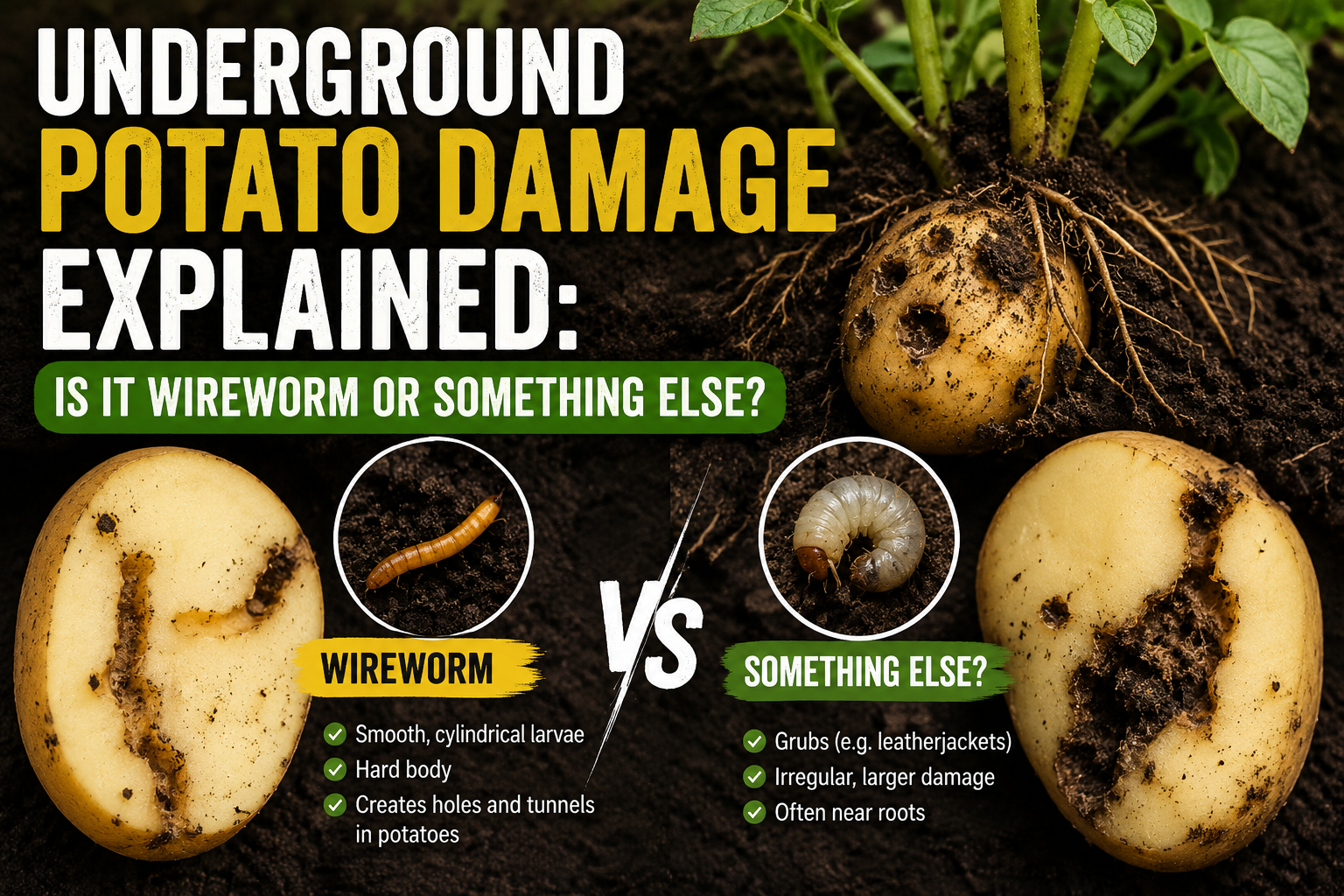
In one potato-producing area where there were good produce, there was a strange issue emerging among the farmers. Much of the so-called-healthy tubers at harvest demonstrated signs of internal damage—little holes, tunnels and inner-browning though they appeared all-right on the outside. Rejection rates at the market were high and growers were not able to determine the precise reason.
One such farmer was Daniel of southern Europe who at first thought that his crops were ill. However, it was later determined after consultation in the field with agronomists and experts in soil science that the diagnosis was a more intractable and less understood culprit the wireworms. The experience has pointed out a severe issue, such as underground damage is not always detectable, but it requires early diagnosis for organic wireworm control.
When Potatoes Look Fine–But Aren’t
Daniel remembers that his crop did not have any significant problems with the growing season. The foliage was green, and well managed irrigation was used to have vigorous plants. But a large proportion of the tubers had small and round holes at harvest.
This kind of damage, experts explained is normally brought about by wireworms which are larvae stage of click beetles. These pests stay in the soil- many years and entirely eat the developing tubers leaving small slender tunnels which makes the quality and marketability poor.
The problem is that this damage occurs underground and this damage is hard to detect and therefore it is too late to access the damage.
The distinction between Wireworm Damage and other Problems
Wireworms are not the cause of all the underground damage. Researchers assisted Daniel in various field studies to differentiate between various pest and disease symptoms.
Damage by wireworms is typically characterised by clean and round holes that go very deep into the tuber. Conversely, the slug damage is usually more sporadic and superficial. Grub feeding usually produces large, coarse holes, and not narrow tunnels.
Disease: Soil born diseases can potentially lead to rotting or discolouration without there being any specific holes of entry.
It is necessary to understand these differences as each problem has to be managed differently.
Why are wireworms hard to control?
The study revealed that the life span of wireworms in the soil was one of the main discoveries. They have a longer lifespan (several years larvae) than most pests and just feed as much as possible.
They are also vertical in the soil profile. They dig further during dry or hot weather. Conditions are favourable and when they occur, they retreat to the root zone where crops are most susceptible.
The behaviour also causes the conventional surface applied insecticide for wireworms to be not very effective in controlling wireworms because the pest is frequently out of reach.
Towards a Bio-based Solution
When Daniel experienced several losses, he started to experiment with other methods suggested by agricultural scientists. The most encouraging of alternatives was metarhizium anisopliae which is a powder form of biological control agent that was made by utilizing the naturally available soil fungi.
Researchers described the mechanism of metarhizium anisopliae that infects insects via direct contact. The spores hitch on the outermost shell of the pest, enter it and injure and eventually kill the insect.
It is especially well suited to dealing with the pests that live a large portion of their lifetime within the soil environment, including the: wireworms.
This is a sustainable and specific measure that can be adopted by growers aiming at using organic methods of getting rid of wireworms.
MET Zone: Biological Control in the Field
Daniel applied MET Zone, a free-flowing formulations aimed at placing metarhizium anisopliae straight into the soil to implement this strategy.
Application of the product was done during soil preparation and at planting. This made sure that there was a presence of the biological agent in the root zone where the wireworms thrived most.
During a season, a significant decrease in damaged tubers was observed in Daniel. Although the results were not instantaneous, the changes in the quality of crops were expected.
The researchers that participated in the research observed that the use of biological solutions can be effective in a long-term management plan and not a simple solution.
Combining Cultural Practices to Improve
Not one intervention led to the success of the approach. Rather, it was the outcome of using biological means in addition to better agricultural methods.
Farm rotation was an important factor in the decreasing number of pests. Areas that used to be grassed were determined as high-risk areas, as they are prone to the presence of wireworms.
There was also adjustment of soil management. The drainage was improved and too much moisture was avoided to provide more unfavourable conditions to the pest.
Early monitoring enabled prompt detection of any resurgence such that any resurgence could be dealt with in good time.
Field Lessons
The experience Daniel underwent is indicative of a bigger pattern in farming. They are not relying on chemical inputs and growingers are converting to integrated measures that integrate cultural practices and biological control.
This strategy does not only decrease the pest pressure but also enhances the health and margin of soil as well as productivity in the long term.
Conclusion
Subsurface damages caused by potatoes may be deceptive and failure to identify the problem will result in poor control practices. The first step to protecting your crop is to distinguish wireworm damage to other causes.
Although the traditional techniques to remove wireworms may have shortcomings, the biological approaches like metarhizium anisopliae powder and targeted version like MET Zone offer a better way forward.
The use of accurate diagnosis, sustainable practices, and soil-based biological tools can greatly decrease losses as the Daniels case illustrates.
In the contemporary farming industry, it is equally vital to know what goes on beneath the is as much as it is important to know what is on top of the ground.
