

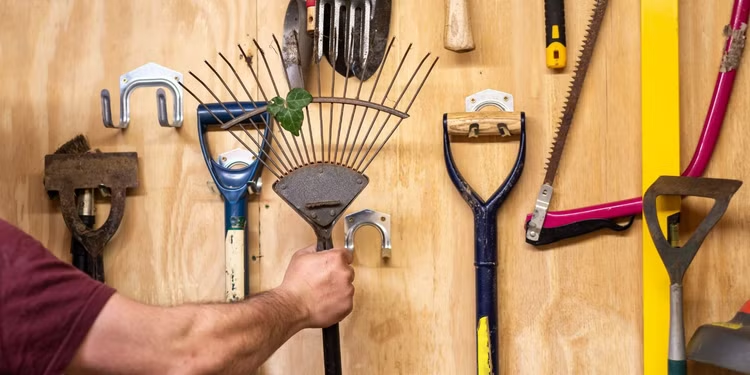
Garden tools do not wear out evenly. They fail at a small number of predictable points, and those points are visible in a shop if a gardener knows where to look. Learning them turns a confusing wall of near-identical spades and secateurs into a short list.
Almost Every Hand Tool Fails in the Same Three Places
Spades, forks, trowels, hoes and rakes share a common anatomy, and they break at the joint between materials rather than in the middle of any one material.
The first failure point is the socket or tang, where the metal head meets the handle. A solid-socket tool, where the metal wraps into a cone that the handle seats inside, resists prying loads far better than a tang pressed into a drilled shaft. A gardener levering a root out of clay is applying exactly the force that separates the two designs.
The second is the handle itself, usually just below the grip on a D-handle spade, where a moulded plastic Y-piece meets the shaft. Timber shafts fail slowly and visibly. Moulded plastic Y-pieces fail suddenly, often at the worst moment.
The third is the cutting edge. On secateurs and loppers it is the pivot bolt, not the blade, that decides the tool’s life. A pivot that can be tightened and a blade that can be replaced make a tool serviceable for a decade. A riveted pivot makes it disposable the day it loosens.
Worth checking on any hand tool before buying:
- Head-to-handle joint. Solid socket beats tang. Riveted through-bolts beat glue.
- Steel behaviour. Carbon steel takes a keener edge and needs oiling. Stainless resists rust and dulls faster in stony soil.
- Handle grain. On ash or hickory, grain should run the length of the shaft, not diagonally across it. Diagonal grain is a crack waiting for a cold morning.
- Balance. A tool that feels head-heavy in the hand will feel exhausting after an hour.
- Serviceability. Can the blade be sharpened, the pivot tightened, the handle replaced?
Powered Tools Are Really Battery Purchases
Cordless mowers, trimmers, blowers and pruners are now the default for domestic gardens, and the tool is the least important part of the decision. The battery platform is the purchase, because it dictates every future addition.
Two things matter more than headline runtime. The first is whether the battery packs remain available for that platform in five years, since a discontinued pack strands an entire tool collection. The second is thermal management, because a pack that gets hot on a long hedge run will throttle, and throttling on a hot August afternoon is when most people conclude that cordless kit is underpowered.
Anyone buying into a platform should also ignore the bundled pack size. The pack that comes in the box is usually the smallest one, chosen to hit a price. Budget for a larger pack separately and the same tool becomes a different experience.
Outdoor Living Gear Fails to Sunlight Before It Fails to Use
Furniture, parasols, cushions, storage boxes and planters lead a harder life than most people credit. Ultraviolet light is the main enemy, and it attacks in a specific order: soft furnishings first, then untreated plastics, then coatings, then the structure.
Practical signs of gear built for real outdoor exposure include solution-dyed fabrics rather than surface-printed ones, powder coating with a visible even build rather than thin spray paint, stainless or coated fixings rather than plain steel screws, and drainage designed into seat pans and planter bases. A cushion that cannot dry out is a cushion that will be mouldy by the second season, no matter what the fabric is.
Timber deserves its own note. Any hardwood used outdoors should carry credible certification, and softwood should be properly pressure treated rather than merely stained. Stain is a colour, not a preservative.
Hoses and Connectors End More Seasons Than Tools Do
Nothing in a garden causes more quiet irritation than a leaking connector. Hose failures are almost always at fittings rather than in the hose wall, and the cause is usually mixed systems: one brand’s quick connector paired with another brand’s tap adaptor, held together with optimism.
The reliable approach is to standardise on a single connector system across taps, hoses, guns, sprinklers and any irrigation timers, then buy spare seals for it. Reinforced multi-layer hose resists kinking far better than single-wall hose, and kinking is what eventually splits a hose at the reel.
Where a Garden Centre’s Range Actually Comes From
There is a part of this that gardeners rarely see. The tools, planters, hose systems and outdoor furniture in a garden centre are not designed by the garden centre. Independent retailers and online sellers build their ranges by selecting from manufacturers, mostly across Asia, and then deciding which get their own label and which keep the maker’s brand.
That selection happens through sourcing platforms and trade exhibitions rather than through catalogues. A trade fair hong kong buyers attend gives access to verified suppliers and to OEM and ODM manufacturers who can produce a garden range to a retailer’s own specification, which is why two competing garden centres often sell visually identical kneelers under different names.
For a gardener, the useful takeaway is that brand name carries less information than construction detail. The same factory frequently supplies several brands at several price points, and the differences between them are real but they sit in the specification, not the logo.
Seeing a Season Before It Reaches the Shelf
Buyers travel because outdoor gear cannot be assessed from an image. Fabric hand, coating thickness, hinge action and handle balance all need a hand on them. The Global Sources Hong Kong Shows at AsiaWorld-Expo run in two phases, 11 to 14 October and 18 to 21 October 2026, and the sports and outdoor categories sit in the second phase alongside lifestyle and smart home products.
Walking the outdoor products show halls is how a buyer compares twenty versions of the same folding chair frame in a morning. Across both phases the event gathers more than 4,200 suppliers and over 8,000 booths carrying more than 330,000 new products, which is enough breadth to see which construction methods are becoming standard and which are being quietly dropped.
Where to Spend and Where to Save
| Item | Spend properly | Acceptable to save |
|---|---|---|
| Spade and fork | Yes, solid socket, timber shaft | No |
| Secateurs | Yes, replaceable blade and pivot | No |
| Hose connectors | Yes, one system, brass or reinforced | No |
| Battery platform | Yes, pack availability matters | No |
| Hand trowel | Mid range is fine | Yes |
| Rakes and brooms | Mid range is fine | Yes |
| Decorative planters | Buy on looks | Yes |
| Kneeling pads, trugs | Buy on price | Yes |
The pattern is consistent: spend on anything that applies leverage, holds pressure or has a moving joint. Save on anything that simply holds soil or moves air.
A Sensible Maintenance Routine Beats an Expensive Tool
Even a well-chosen kit degrades without a routine, and the routine is short. Clean soil off steel before storing, wipe carbon steel with an oily rag at the end of a session, sharpen secateurs and spade edges at least twice a season, store batteries indoors at partial charge over winter, and drain and coil hoses before the first frost.
Tools bought on these principles and maintained this way tend to leave the garden centre once and stay. That is the actual measure of value in garden kit: not what it cost in spring, but whether it is still in the shed, working, five springs later.
